
It's no Use Prevaricating About the Bush...
Holiday nostalgia and neuroqueer vibes with Wallace & Gromit in The Wrong Trousers!

It’s been a long, long year folks and my life has been turned upside down in the last couple of months, with new and interesting challenges on the way that have absolutely nothing to do with writing. It’s been hard to focus on anything except the most essential tasks/deadlines and work has felt a lot like putting out the most immediate fires by attending only to the most urgent deadlines. By consequence, this newsletter, which is nothing but a labour of love, suffered from considerable neglect.
Welcome to AutCasts, a free newsletter exploring neurodivergence through cinema’s oddballs, misfits & rebels!
Still I wanted to round out the year by returning to one of my favourite childhood animations: Wallace and Gromit’s The Wrong Trousers. It’s not exactly a holiday movie, and my repeated rewatching of the complete Wallace and Gromit oeuvre was not limited to the holidays. Nevertheless, the cutesy, cosy English countryside vibe feels particularly evocative of long winter days curled up by the fire in pyjamas while chomping my way through seasonal boxes of Cadbury’s Roses.
The Wrong Trousers is a 1993 British stop-motion animated short film produced by Aardman Animations studio and written and directed by Nick Park. Wallace (Peter Sallis) and Gromit find themselves short of money after Wallace’s splurge on a pair of ex-NASA “techno trousers” whose only apparent function is to take Gromit for walkies. Wallace decides to take in a lodger and their first, and only applicant, is a suspicious looking penguin: Feathers McGraw. Feathers immediately works to push Gromit out of his room and then out of the house while ingratiating himself with Wallace. Homeless and bereft, Gromit soon discovers that Feathers is a wanted criminal who plans to use the techno trousers steel a priceless diamond from the local museum and pin the crime on Wallace.
Well, this is a fine how do you do, isn't it, Gromit?
The Wrong Trousers is the second instalment in the beloved stop-motion animation franchise that has lasted almost forty years. From 1989’s A Grand Day Out to 2024’s Vengeance Most Fowl, Wallace, an affable and sometimes naive bachelor, and his faithful dog Gromit have built their own spaceship, taken it to the moon, come up with numerous timesaving inventions, become entangled with many unscrupulous characters and solved multiple crimes. At the heart of each movie is Wallace and Gromit’s friendship, which endures despite communication differences and Wallace’s frequent betrayals of Gromit.
Wallace is the only character who speaks in A Grand Day Out and The Wrong Trousers, with Gromit and Feathers using body language, facial expressions and actions to communicate a whole range of complex emotions, opinions and feelings. Wallace treats Gromit like a friend or housemate most of the time, but also like a pet when it suits him. He likes to pretend he’s oblivious to Gromit’s frequent expressions of exasperation or impatience and often seems to talk at him, rather than to him. Gromit mostly does his own thing: reading the newspaper, modern philosophy or mechanics for dogs and paying little heed to Wallace’s nattering, with frequent eye rolls in response to Wallace’s most recent fixation. Yet they care deeply about each other and, on this latest rewatch, I couldn’t help but feel they acted like an old married couple (or a couple of old queers).
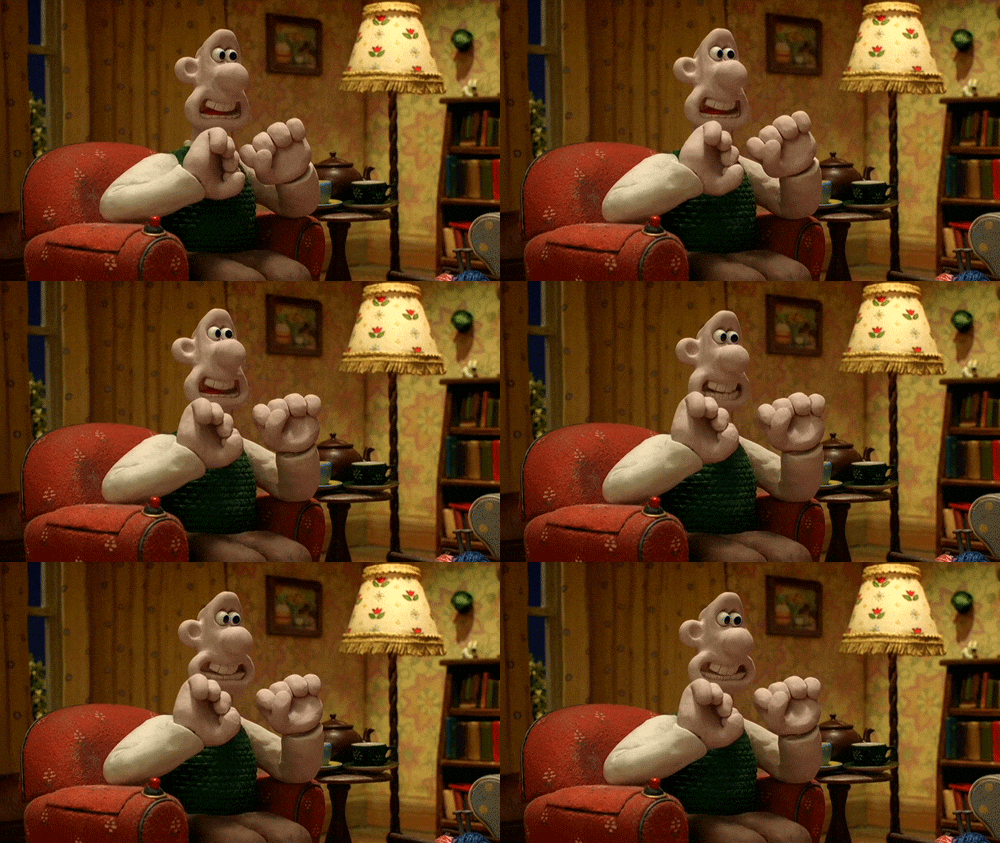
Their communication differences are not a source of friction, nor an obstacle in their relationship. This makes Wallace and Gromit, you could argue, one of the few on-screen instances of representation for non-speaking characters. Of course, all the non-speaking characters are animals but those animals are also anthropomorphised to a large degree and are meant to be understood as characters of equal worth, intellect and interest. At a stretch you could even say that Wallace and Gromit are an example of successful queer and interspecies kinship, though I’m sure this is not what Aardman intended when they started out.
In this author’s humble opinion, Wallace shares many characterstics with autistic people. He frequently stims when feeling both positive and negative emotions, has an incredible capacity for invention. His inventions are intended to support a very set routine, including mobility aids (the techno trousers) and other time-saving devices. He often misses or misreads social cues and is, with the exception of Gromit, quite a loner.
What a shocking calam... calam... calamity...
Wallace and Gromit live together in relative harmony until Feathers McGraw arrives on the scene. Wallace is immediately enamoured with their new “paying guest” and Gromit is immediately suspicious. Wallace remains oblivious to Feathers’ shifty nature. Gromit, who has literally been pushed into the cold, soon notices Feathers’ nightly wanderings and other suspicious activities. He is the first to realise that Feathers disguises himself as a chicken who has a bounty on his head. Ultimately, Gromit must save Wallace from Feathers’ attempt to frame him for stealing the diamond.
Wallace takes Feathers at face value and is unable to see who Feathers really is until it’s too late. He can’t even prevent Feathers from taking over Gromit’s room and rather than provoking confrontation makes Gromit move into the spare room. Gromit sees right through Feathers but is alone in this perception and so feels cast out from the fold. The worst part is, Wallace choses novelty and financial gain over their years of friendship and lets Gromit go.
One strange, and often painful, thing about the autistic experience is that I have found myself on both sides of this equation: easily taken in by someone or immediately suspicious. The former has resulted in painful breaches of trust, being taken advantage of and feeling like an idiot for not noticing the dynamic sooner. In other instances, I have been immediately wary of someone who is a charismatic or well-liked individual within a specific group. It is very disorienting to realise you’re the only person who feels unease about a certain individual especially when, like Gromit, you can’t really pinpoint why you feel uneasy about them. I’ve learned the hard way that in such cases to raise concerns or express unease about this person can be seen as a challenge to the group orthodoxy. This too often results in a loss of community, either through withdrawal or expulsion. In the worst cases, I have experienced both dynamics with the same person, which only compounds the sense that I can’t trust my own perception of people or reality.
In the four years (!!) since my diagnosis I’ve been trying to make sense of this apparent contradiction and I still have no concrete answers. I suspect it has much to do with difficulties in understanding neurotypical social cues and a hypersensitivity to certain brands of insincerity or incoherency even as I usually (erroneously??) assume most people are telling the truth most of the time. I’m sure this is bound up with masking, my failure, over many years, to heed my gut instincts when it came to people and my desperate need for social acceptance which meant I let people trample all over my boundaries far too often.
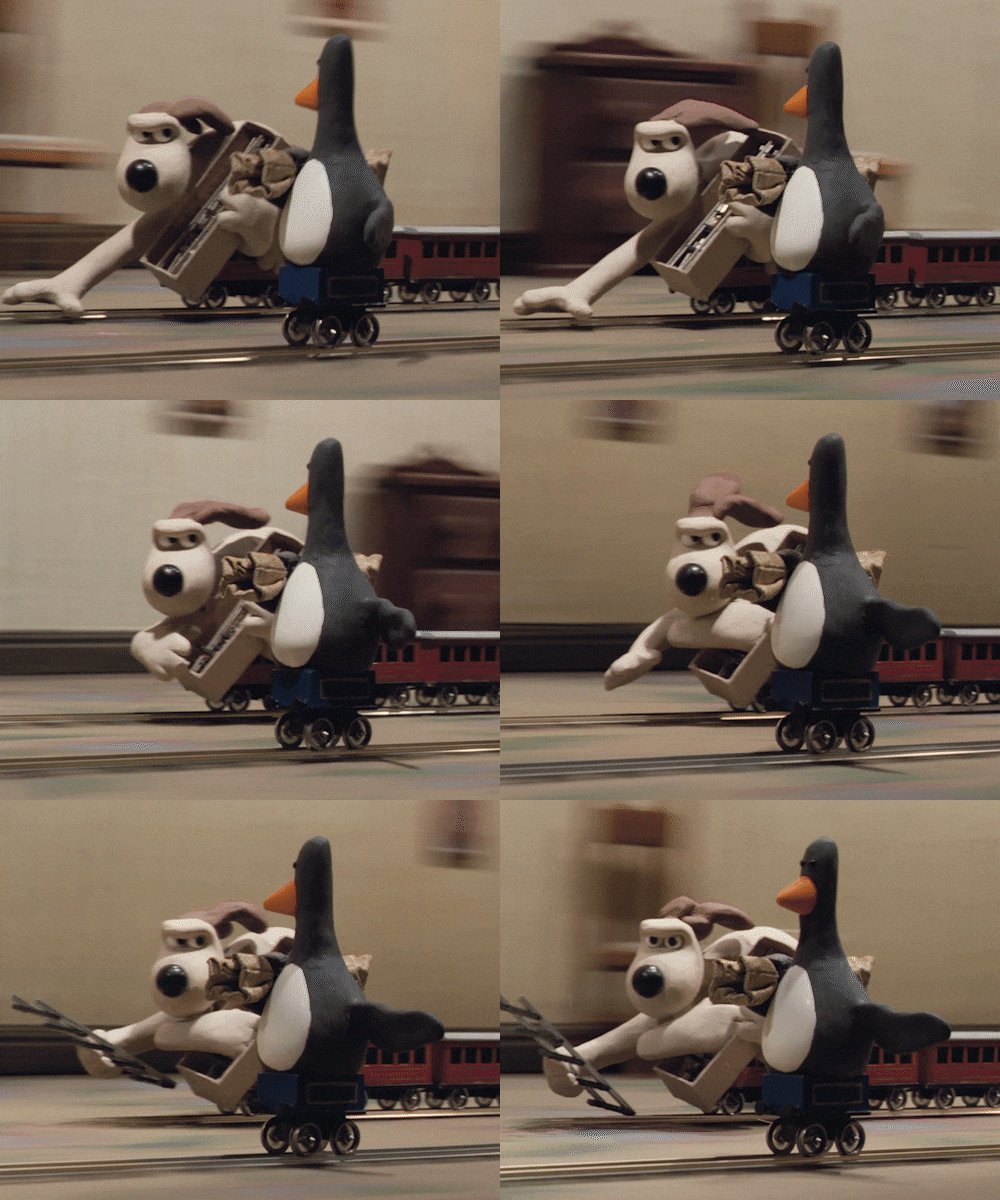
So the real calamity of The Wrong Trousers is not Feathers attempt to frame Wallace, but the fact that Wallace abandons his best friend (partner??) for the new lodger without a second thought. He does not even realise Gromit has left the house with his most precious possessions: an alarm clock and a photo of him and Wallace. Only once Wallace is in trouble, having been literally kidnapped by the techno trousers, does he even remember that Gromit exists. He immediately appeals to Gromit for help and, to Gromit’s credit, he does not abandon Wallace. There follows a high speed model train chase, where Gromit succeeds in capturing Feathers. This secures the reward money which solves their financial troubles and means they no longer need a lodger!
All’s well that ends well, that’s what I say.
Phew! It’s astonishing (and a lesson in economy of storytelling) just how much Aardman can squeeze into a 30 minute movie. And we haven’t even mentioned the Mission Impossible style burglary!
But we might just leave it there fore today, and for the year, because, as Wallace says: A good doze, that's what I need…!
Maybe a good doze is what we all need after 2025? I wish I could say my only plan was to sleep and watch movies until January 5th but the agenda of seasonal meet and greets with people who are home for the holidays is already bursting.
If you liked what you read, please tap the heart 💕 below and consider subscribing (for free) or sharing this essay. As an independent writer it’s the best way to support my work!
Some writing news!
In October I had a piece in Literary Hub celebrating 30 years of one of my favourite literary series: His Dark Materials!
Pullman understands that true evil is never about the distorted cravings of a single person. Evil is aided and abetted by the banality of institutions and their functionaries who, as Lord Asriel says, have “tried to suppress and control every natural impulse. And when it can’t control them, it cuts them out.” Evil is aided and abetted by those who stand back and do nothing, who swallow the lies and turn away from images of death and destruction that are wholly preventable.
You can read the full piece here!
And for those of you based in Ireland, I’ll be facilitating a discussion at Doolin Writers Weekend in January on “Writing the Other”. Expect lots of chats about the thorny issues of representation of LGBTQIA+ people and more. If you’re about the Wesht of Ireland that weekend it would be great to see you!
So nice to have you back in my inbox! I hope you had a restful festive break 💕